Guide to Building AI Software with Python: A Step-by-Step Roadmap for Beginners
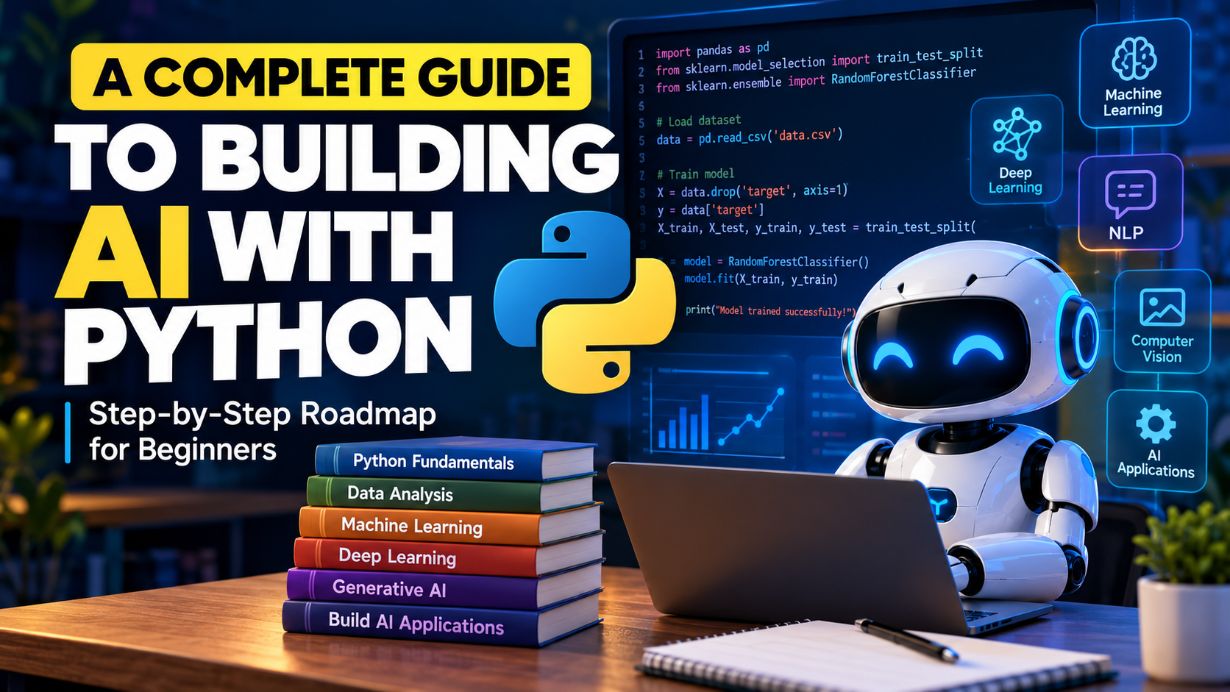
Guide to Building AI Software with Python: A Step-by-Step Roadmap for Beginners
Artificial Intelligence is transforming how modern software is built. From chatbots and recommendation systems to image recognition and intelligent assistants, AI is becoming an important part of software development. This guide explains how beginners can use Python to gradually learn the skills needed to build practical AI software.
What You Need to Know Before Learning AI
You do not need to become an AI expert before writing your first AI program. The best approach is to learn the fundamentals gradually and build projects as your knowledge improves.
Python is one of the most popular programming languages for Artificial Intelligence because it has a large ecosystem of libraries and frameworks for data analysis, machine learning, deep learning and AI application development.
A typical learning journey looks like this:
Python

↓
Mathematics
↓
Data
↓
Machine Learning
↓
Deep Learning
↓
AI Specialization
↓
Generative AI / LLMs
↓
AI Engineering
↓
Web Applications
↓
Deployment
↓
Production AI Software
1. Learn the Fundamentals of Python
Python should be your first major step if you want to build AI software. You do not need to master every feature of Python before starting AI, but you should be comfortable writing and understanding Python programs.
Important Python Topics to Learn
- Variables and data types
- Strings and numbers
- Lists, tuples, dictionaries and sets
- Conditional statements
- Loops
- Functions
- Modules and packages
- Exception handling
- File handling
- Object-oriented programming
- Working with APIs
- Virtual environments
- Installing Python packages with pip
For example:
name = "Edwin"

if name:
print(f"Hello, {name}!")
Before moving deeply into AI, try building small applications such as a calculator, to-do application, quiz application, expense tracker or weather application.
These projects help you develop the programming skills you will later use when building AI applications.
2. Learn the Mathematics Behind AI
Mathematics plays an important role in machine learning and deep learning. However, beginners do not need to become mathematicians before starting. You can learn the mathematics progressively as you study AI.
Algebra
- Variables
- Equations
- Functions
- Graphs
- Exponents
- Logarithms
Statistics
- Mean
- Median
- Mode
- Variance
- Standard deviation
- Probability
- Distributions
- Correlation
Linear Algebra
Linear algebra becomes particularly important when working with machine learning models.
- Vectors
- Matrices
- Matrix operations
- Dot products
- Dimensions
Calculus
For deeper machine learning and neural networks, learn the basics of:
- Derivatives
- Gradients
- Partial derivatives
- Optimization
3. Learn How Data Works
AI systems depend heavily on data. Machine learning models learn patterns from data, which makes understanding how to collect, clean, organize and analyze information extremely important.
Learn how to work with:
- CSV files
- JSON
- Databases
- APIs
- Text data
- Images
- Audio
- Numerical data
Two important Python libraries for data work are NumPy and Pandas.
import pandas as pd

data = pd.read_csv("students.csv")

print(data.head())
You should also learn data cleaning because real-world datasets are rarely perfect. They may contain missing values, duplicate records, incorrect values, inconsistent formats and outliers.
4. Learn Data Visualization
Data visualization allows you to understand datasets and discover patterns before training a machine learning model.
Popular Python visualization tools include:
- Matplotlib
- Seaborn
- Plotly
You can use these tools to visualize sales, student performance, population data, product prices and customer behavior.
5. Learn the Fundamentals of Machine Learning
Machine learning is one of the major branches of Artificial Intelligence. Instead of explicitly programming every rule, a machine learning system learns patterns from data.
Supervised Learning
Supervised learning uses labeled examples to train a model. For example, a model could learn the relationship between house size and house price.
Common supervised learning tasks include:
- Classification
- Regression
Unsupervised Learning
Unsupervised learning works with data without predefined labels. It can be used for tasks such as customer segmentation and finding patterns within datasets.
Reinforcement Learning
Reinforcement learning involves an agent interacting with an environment and learning through rewards and penalties. It is commonly associated with areas such as games, robotics and decision-making systems.
6. Learn Scikit-learn
Scikit-learn is an excellent Python library for beginners learning traditional machine learning.
It provides tools for:
- Classification
- Regression
- Clustering
- Data preprocessing
- Model evaluation
- Feature selection
- Model training
from sklearn.linear_model import LinearRegression

model = LinearRegression()

model.fit(X_train, y_train)

prediction = model.predict(X_test)
The Machine Learning Workflow
Collect Data
 ↓

Clean Data
↓
Explore Data
↓
Prepare Features
↓
Split Dataset
↓
Train Model
↓
Evaluate Model
↓
Improve Model
↓
Deploy Model
Understanding this workflow is more important than simply memorizing individual machine learning algorithms.
7. Learn How to Evaluate AI Models
Training an AI model is only part of the process. You also need to determine whether the model performs well on new data.
Depending on the problem, you may encounter metrics such as:
- Accuracy
- Precision
- Recall
- F1-score
- Mean Absolute Error
- Mean Squared Error
- Confusion matrix
Overfitting
Overfitting occurs when a model performs extremely well on its training data but performs poorly on new data.
Underfitting
Underfitting occurs when a model is too simple to properly learn the patterns within the data.
Training and Testing Data
Machine learning datasets are commonly divided into training and testing portions. The testing data allows you to evaluate the model using examples it has not previously seen.
8. Learn Deep Learning
Deep learning is a specialized area of machine learning that uses artificial neural networks containing multiple layers.
Deep learning is widely used for tasks involving images, text, speech, video and other complex data.
Popular Deep Learning Frameworks
- PyTorch
- TensorFlow
- Keras
Basic Neural Network Workflow
Input Data
↓

Neural Network
↓
Training
↓
Loss Calculation
↓
Optimization
↓
Improved Model
Beginners should start with small datasets and relatively simple models before attempting complex neural networks.
9. Learn Computer Vision
Computer vision focuses on enabling computers to understand images and video.
Useful technologies include:
- OpenCV
- Pillow
- PyTorch
- TensorFlow
You can build projects such as:
- Image classifiers
- Object detection systems
- Document scanners
- Image recognition applications
- Camera-based AI applications
Image

↓
Preprocessing
↓
AI Model
↓
Prediction
↓
Result
10. Learn Natural Language Processing
Natural Language Processing, commonly known as NLP, focuses on enabling computers to work with human language.
NLP can be used for:
- Text classification
- Sentiment analysis
- Text summarization
- Question answering
- Search systems
- Chatbots
- Document analysis
Technologies you may encounter include:
- NLTK
- spaCy
- Transformers
- Large Language Models
11. Learn How Modern AI Models Work
Modern AI development does not always require developers to train a model completely from scratch.
Developers can use existing AI models through APIs, open-source models and machine learning frameworks to create sophisticated applications.
Your Python Application
      ↓
  AI API / Model
      ↓
   AI Response
      ↓

Your Application
This approach can be used to build:
- AI chatbots
- AI writing assistants
- Document analysis tools
- AI tutors
- Customer-support systems
- Coding assistants
- Voice applications
12. Learn APIs
APIs are extremely important when building modern AI applications. They allow your Python software to communicate with other services.
import requests

response = requests.get(
"https://example.com/api/data"
)

data = response.json()

print(data)
Once you understand APIs, you can connect Python applications to AI services, databases and other software systems.
13. Learn Large Language Models and Generative AI
Large Language Models, commonly called LLMs, are AI models designed to process and generate human language.
Important concepts to learn include:
- Tokens
- Prompts
- Context windows
- Embeddings
- Vector databases
- Retrieval-Augmented Generation (RAG)
- Fine-tuning
- Model inference
- AI agents
- Tool calling
Example of a RAG Application
User Question
  ↓

Search Knowledge Base
↓
Retrieve Relevant Information
↓
Send Context to AI Model
↓
Generate Answer
↓
Display Answer
This architecture can be useful for AI applications that need to answer questions using a company's own documents or knowledge base.
14. Learn Databases
AI applications often need databases to store users, conversations, documents, predictions and other information.
Learn at least one relational database such as:
- PostgreSQL
- MySQL
- SQLite
You should understand:
- Tables
- Relationships
- Primary keys
- Foreign keys
- Queries
- Indexes
- CRUD operations
As you progress into modern AI development, you may also encounter vector databases, which can be used to store and search embeddings.
15. Learn Web Development
If your goal is to build complete AI software rather than simply experiment with models, web development becomes extremely useful.
Python frameworks such as Django and FastAPI can be used to create the backend of AI-powered applications.
             User
           ↓
    Web Application
           ↓
    Python Backend
           ↓
   AI Model / API
           ↓
      Database
For example, you could build an AI web application where users create accounts, submit questions, upload documents and receive AI-generated responses.
16. Build Your First Complete AI Project
Once you have learned the fundamentals, don't spend all your time watching tutorials. Start building.
A good first project could be an AI chatbot.
Frontend

↓
Django / FastAPI
↓
Python AI Service
↓
AI Model / API
↓
Response
↓
Frontend
You can gradually add:
- User accounts
- Conversation history
- Database storage
- File uploads
- Authentication
- Search
- AI-generated summaries
- Admin dashboard
This is where your knowledge starts coming together to create an actual AI-powered software product.
17. Learn AI Application Security
AI applications need security just like other types of software. Developers should understand how to protect both the application and the data it processes.
- API key protection
- Authentication
- Authorization
- Input validation
- Rate limiting
- Data privacy
- Secure file uploads
- Prompt injection
- Sensitive-data protection
18. Learn How to Deploy AI Applications
Building an application locally is only one part of software development. Eventually, you need to learn how to deploy your AI application so other people can use it.
Useful technologies and concepts include:
- Linux
- Git and GitHub
- Servers
- Domains
- HTTPS
- Environment variables
- Docker
- Web servers
- Application servers
- Cloud platforms
Idea

↓
Python Development
↓
AI Model / API
↓
Database
↓
Web Application
↓
Testing
↓
Git
↓
Server
↓
Deployment
↓
Monitoring
A Practical AI Learning Roadmap
If you're starting from the beginning, you can organize your AI learning journey into the following stages.
Stage 1 — Programming
Learn Python, Git, Linux basics, APIs and object-oriented programming.
Project goal: Build 5–10 small Python applications.Stage 2 — Data
Learn NumPy, Pandas, visualization, statistics and data cleaning.
Project goal: Build data-analysis projects.Stage 3 — Machine Learning
Learn Scikit-learn, regression, classification, clustering and model evaluation.
Project goal: Build prediction and classification applications.Stage 4 — Deep Learning
Learn neural networks, PyTorch or TensorFlow, training, loss functions and optimization.
Project goal: Build image or text classification systems.Stage 5 — AI Specialization
Choose an area such as generative AI, NLP, computer vision, speech AI or recommendation systems.
Project goal: Build specialized AI projects.Stage 6 — AI Engineering
Learn LLM integration, RAG, embeddings, vector databases, APIs and AI agents.
Project goal: Build complete AI-powered applications.Stage 7 — Production
Learn security, testing, Docker, deployment, monitoring and scaling.
Project goal: Build production-ready AI software.AI Projects You Can Build While Learning
One of the best ways to learn AI is by building projects. Instead of measuring your progress only by the number of courses completed, measure it by the applications you can actually create.
Beginner Projects
- Spam message classifier
- Simple recommendation system
- House-price prediction model
- Student-performance predictor
- Sentiment analyzer
Intermediate Projects
- Image classification application
- AI document analyzer
- Customer-support chatbot
- Recommendation engine
- Face-detection application
Advanced Projects
- AI-powered educational platform
- Document question-answering system
- AI coding assistant
- AI customer-service platform
- AI-powered business analytics system
Do You Need to Build an AI Model From Scratch?
Not necessarily.
This is an important concept for beginners. There is a difference between AI research and AI application development.
If you want to become an AI researcher, you may eventually need to understand how models are designed, trained and optimized.
However, if your goal is to build useful AI software, you can often combine existing AI models and services with your own software.
Existing AI Model
   +

Python
+
Django / FastAPI
+
Database
+
Frontend
=
AI Application
This allows developers to focus on solving real-world problems instead of rebuilding every AI model from zero.
The Most Important Skill: Problem Solving
Learning AI is not simply about learning Python libraries or memorizing machine learning algorithms.
One of the most valuable skills is learning how to take a real-world problem and determine whether AI can help solve it.
For example, imagine a school receives hundreds of documents and needs a way to quickly search for information.
A possible AI solution could look like this:
Documents
↓

Text Extraction
↓
Embeddings
↓
Vector Database
↓
AI Model
↓
Question
↓
Answer
The developer's job is to design the system, select appropriate technologies, integrate the different components and make the application reliable and useful.
Final Advice for Beginners
Don't try to learn everything about Artificial Intelligence at once.
Start with Python. Then learn data, machine learning and deep learning. After that, choose an area such as generative AI, computer vision or NLP. Finally, learn how to combine AI models with databases, APIs, web applications and cloud infrastructure.
Most importantly, build projects while you learn.
A developer who has built several small AI applications can develop a much deeper understanding than someone who has only completed theoretical courses.
The AI Developer Journey
Learn → Build → Make mistakes → Improve → Build again.
You don't need to know everything before starting. Start with Python, build something small and gradually increase the complexity of your projects.
Frequently Asked Questions
Can I learn AI with Python if I am a beginner?
Yes. Python is one of the most accessible programming languages for beginners and has a large ecosystem of AI and machine learning libraries. Start with Python fundamentals before moving into machine learning.
Do I need advanced mathematics to learn AI?
You don't need advanced mathematics to start building simple AI applications. However, mathematics becomes increasingly important as you move into machine learning theory, deep learning and AI research.
How long does it take to learn AI?
There is no fixed amount of time. Your progress depends on your programming background, study time and the complexity of the AI systems you want to build. Consistent practice and project-based learning are more important than rushing through a fixed schedule.
Do I have to train my own AI model?
No. Many developers build AI applications by integrating existing models and AI services through APIs or open-source machine learning models.
Can Python be used to build complete AI applications?
Yes. Python can be used for data processing, machine learning, AI model integration, backend development and many other parts of an AI application. Frameworks such as Django and FastAPI can also be used to build the backend of AI-powered web applications.
Comments
0Sign in with Google to join the conversation.
Continue with GoogleNo comments yet. Be the first to comment!